

Key takeaways
- An office changes hiring and partnerships. It does not change where your data lives.
- Your attack surface moves only when your own infrastructure, vendors, or data paths move.
- Before you tell a client anything about regional hosting, check the region list and your own data flow.
The office is not the infrastructure
A Big Tech office in Lahore or Islamabad lands in your inbox as good news. Then the client's security questionnaire asks where personal data is stored, and the office has no answer. It is a building with staff, not a place your bytes sit.
Verify the news first. Pull the official announcement from Google's own newsroom or the Pakistani press outlet that reported it, and quote only what it says. Do not write "Google now hosts data in Pakistan" because nobody has said that.
Judge the change by what it adds or removes from your attack surface. A local office adds no new endpoint, no new subprocessor, and no new network path into your app. It may add a partner relationship later, and that is the part worth watching.
The simplest answer, and why it is not enough
The simplest answer is "our stack is on AWS, so we are fine." It is a reasonable default, and it is not enough.
You still need to know which region holds each store. Check it directly:
aws rds describe-db-instances \
  --query "DBInstances[].{id:DBInstanceIdentifier,az:AvailabilityZone}"
aws s3api get-bucket-location --bucket client-uploads-prod
Write the answers into the data map, not into your memory. A review asks for the map, and "we think it is in Frankfurt" fails.
The real work is the path, not the pin
Real exposure lives in the paths data takes. Logs ship to a third-party tool. Backups replicate to a second region. A transcription API receives raw uploads.
Each of those is a subprocessor. Each one goes on the list with a region, a purpose, and a retention period.
- Application database: region, encryption at rest, backup region
- Object storage: bucket region, public access block, lifecycle rule
- Logs and error tracking: vendor, region, retention in days
- AI or email APIs: vendor, what fields leave your system
When a new office opens, none of those rows change. The client still asks about them.
What I have not figured out yet
I do not know whether local Big Tech presence will shift how Pakistani clients weigh regional hosting. Some may start asking for in-country storage. Others will keep accepting a US or EU region with a signed DPA. I would rather find out from two or three real questionnaires than guess now.

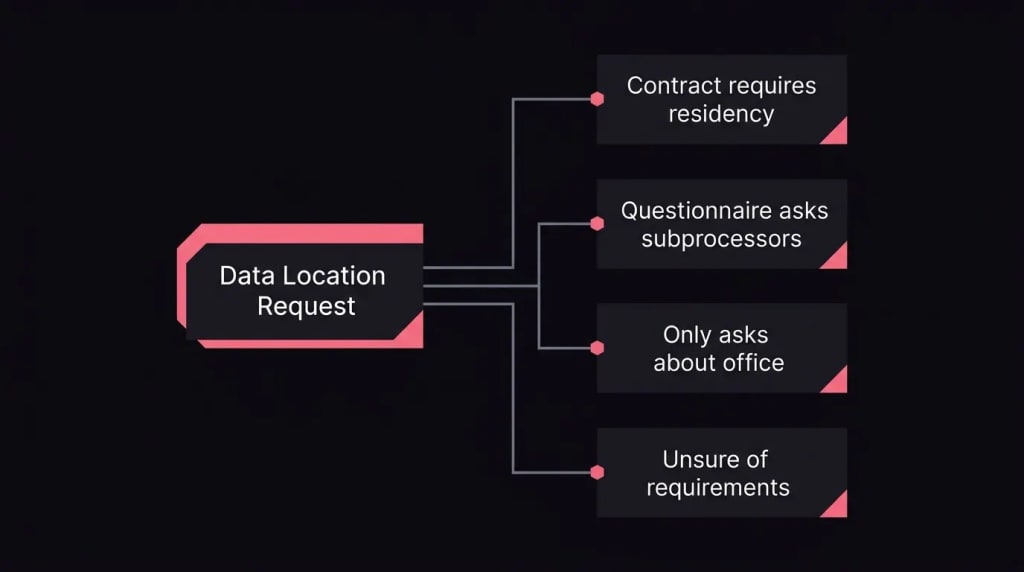
The advice stops applying the moment a client has a hard residency requirement written into a contract. Then the region is not a preference. It is a constraint, and you design around it before the first deploy, not after the audit.
What does your data map say today about where your logs and backups actually land?
Enjoyed this article?
Get notified when I publish new posts on SaaS, Laravel, and remote engineering.