Everyone is posting about Gemini 2.5 Pro. Most posts are just the announcement reworded. This is not that.
Here is what the release actually changes if you build and ship software for a living.
What Google Released
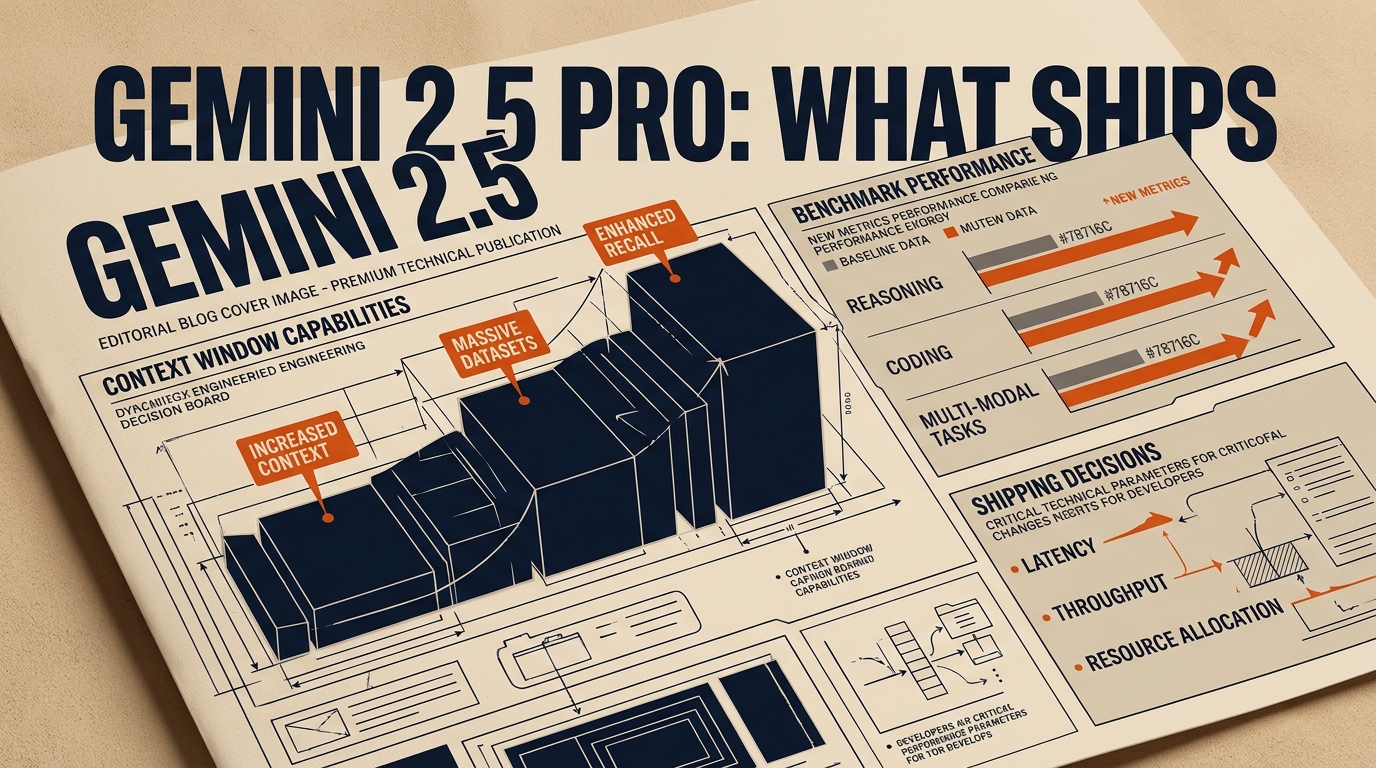
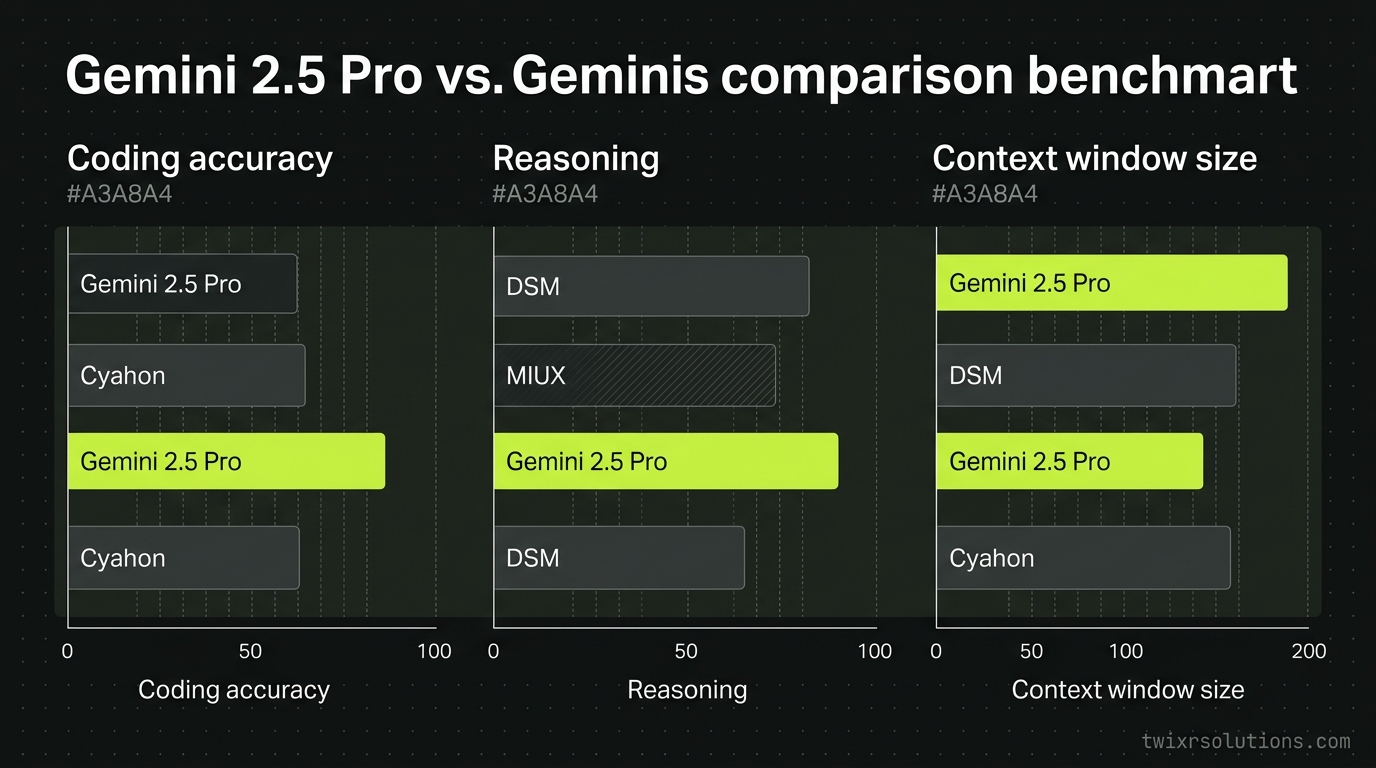
Google released Gemini 2.5 Pro in early 2025. The headline numbers, taken directly from Google's own release page and the LMSYS / LMArena leaderboard, are:
- 1 million token context window - roughly 750,000 words or a large codebase in a single prompt
- State-of-the-art scores on coding and reasoning benchmarks - it sits at or near the top of the public LMArena leaderboard at the time of release
- Multimodal input - text, image, audio, video, and code in one call
- Available via Google AI Studio and the Gemini API (Vertex AI)
Source: Google DeepMind blog and LMArena leaderboard.
Three Things That Actually Change for Builders
1. The 1M context window is not a gimmick - it changes how you structure calls
A 128k window forced you to chunk documents, manage embeddings, and build retrieval pipelines for anything large. That is real engineering effort.
At 1M tokens you can drop a full codebase, a multi-hundred-page PDF, or an entire conversation history into a single prompt and skip the chunking layer entirely for many use cases.
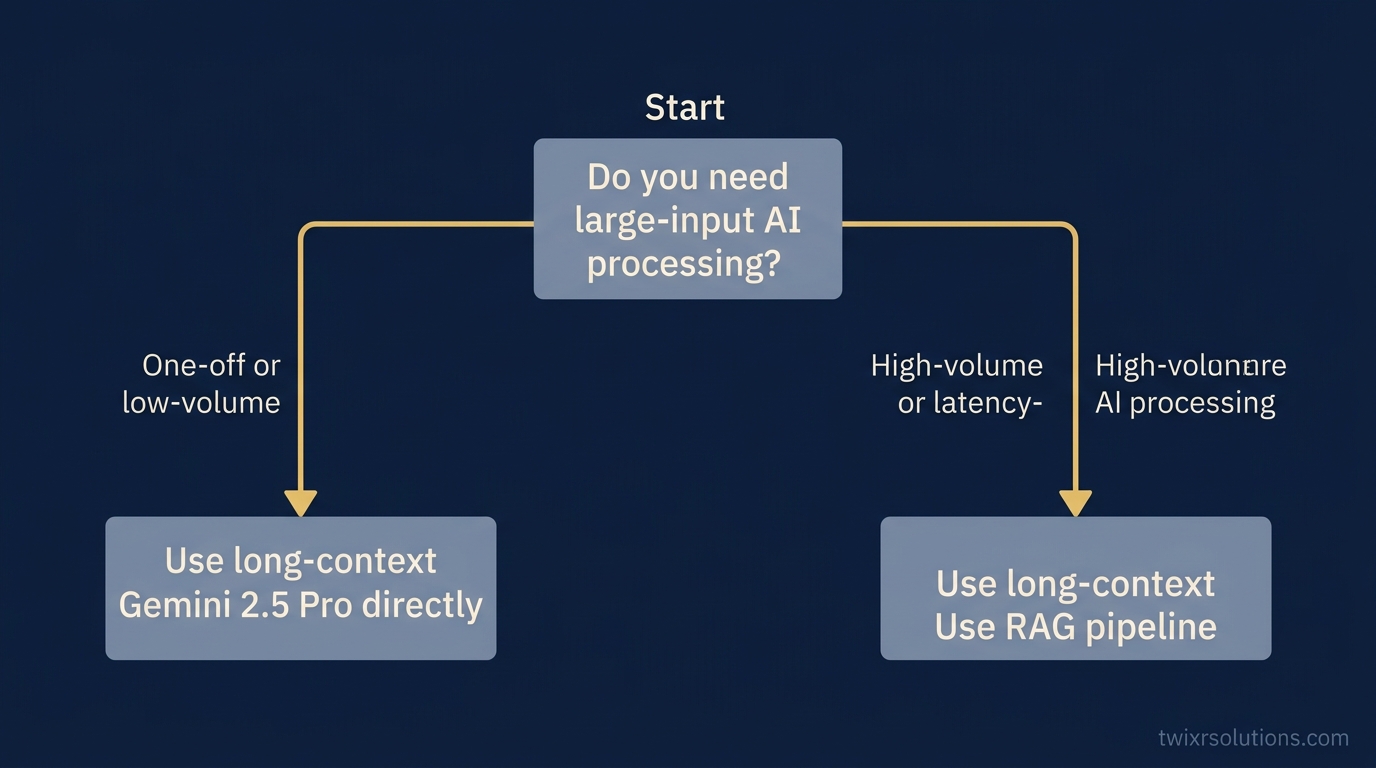
This does not kill RAG. For production systems where you need freshness, precision, or cost control, RAG still wins. But for one-off analysis tasks, code review across a whole repo, or contract parsing - the chunking overhead is now optional, not mandatory.
Practical shift: prototype first with the long context, move to RAG only when cost or latency demands it.
2. Coding quality at this level makes AI-assisted PR review credible
The benchmark gains on coding tasks are not marginal. If you have been using a model as a coding assistant and found it missing subtle logic bugs or hallucinating API signatures, the gap between this generation and the previous one is noticeable in real use.
What this enables in a real workflow:
- Feed a full diff plus the relevant files (not just the diff) and ask for a structural review
- Use it to write integration tests against an existing codebase it can read end-to-end
- Summarize dependency changelogs and flag breaking changes before an upgrade
None of this replaces a code review. It reduces the cognitive load on the first pass.
3. Multimodal in one call simplifies tool count
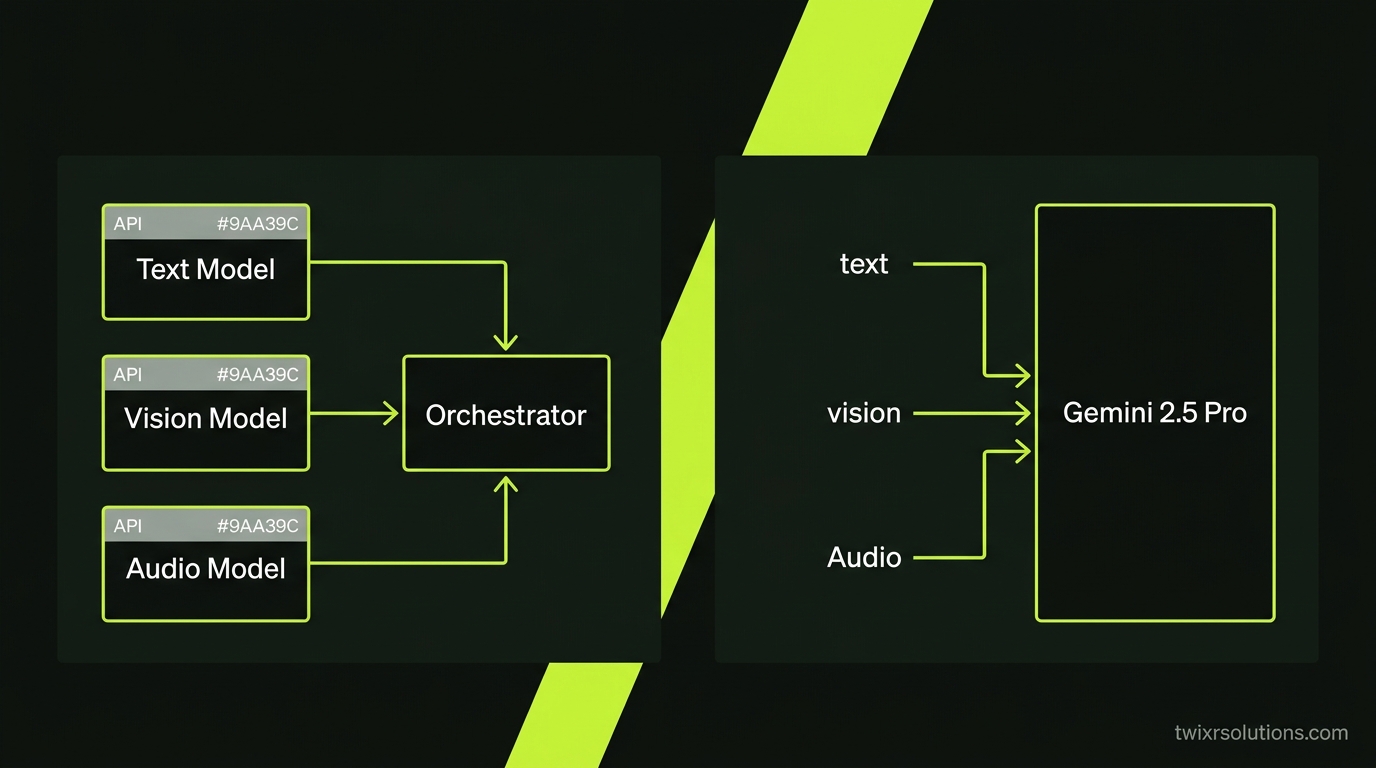
Before this generation you often needed separate models for different modalities - one for text, one for vision, another for audio transcription. Gemini 2.5 Pro handles all of them in a single API call.
For a project like AI Content Automation (Gemini), that means fewer moving parts, fewer latency hops, and a simpler cost model.
If you are building anything that touches mixed inputs - screenshots, voice memos, PDFs, and text in the same workflow - this consolidation matters.
What Has Not Changed
Cost at scale. A 1M-token context call is not cheap. If you are running high-volume pipelines, the per-token cost at that context length still makes chunked retrieval the right call for production workloads. Check the current pricing on the Gemini API pricing page before committing to long-context calls in a hot path.
Hallucination risk. Bigger and smarter does not mean reliable on facts it was not trained on. Grounding, tool calls, and RAG still matter for anything that needs to be accurate.
Latency. 1M-token prompts take time to process. If your user is waiting on a response, this is not the model for that path without careful design.
The Short Version
Gemini 2.5 Pro is worth testing if you ship AI-assisted tooling. The context window is the most immediately useful change - it reduces plumbing for large-input tasks. The coding quality improvement is real enough to warrant dropping it into your review workflow.
It does not change the fundamentals. You still need to design for failure, control costs, and verify outputs.
If you want to see what this kind of model integration looks like in a production workflow, the AI Automation & Chatbots page covers the patterns I use in client builds.
And if you are working with AI agents wired into other platforms, the related post on the Upwork MCP Server: The AI Agent Now Built Into Your Freelance Account shows how these new model capabilities translate to real tooling integrations.
Which part of your current stack would benefit most from a 1M-token context window? Drop it in the comments - curious what actual builders are sitting on.
Frequently asked questions
Google released Gemini 2.5 Pro with a 1 million token context window, which is large enough to hold a substantial codebase or hundreds of pages of documents in a single prompt.
Not for production at scale. The long context window reduces plumbing for one-off or low-volume tasks, but for high-volume pipelines where cost and latency matter, a chunked RAG approach still makes more sense.
Yes. As of the release announcement, Gemini 2.5 Pro is available through Google AI Studio and the Gemini API on Vertex AI. Check the official Google DeepMind and Vertex AI pages for current availability and pricing tiers.
Enjoyed this article?
Get notified when I publish new posts on SaaS, Laravel, and remote engineering.