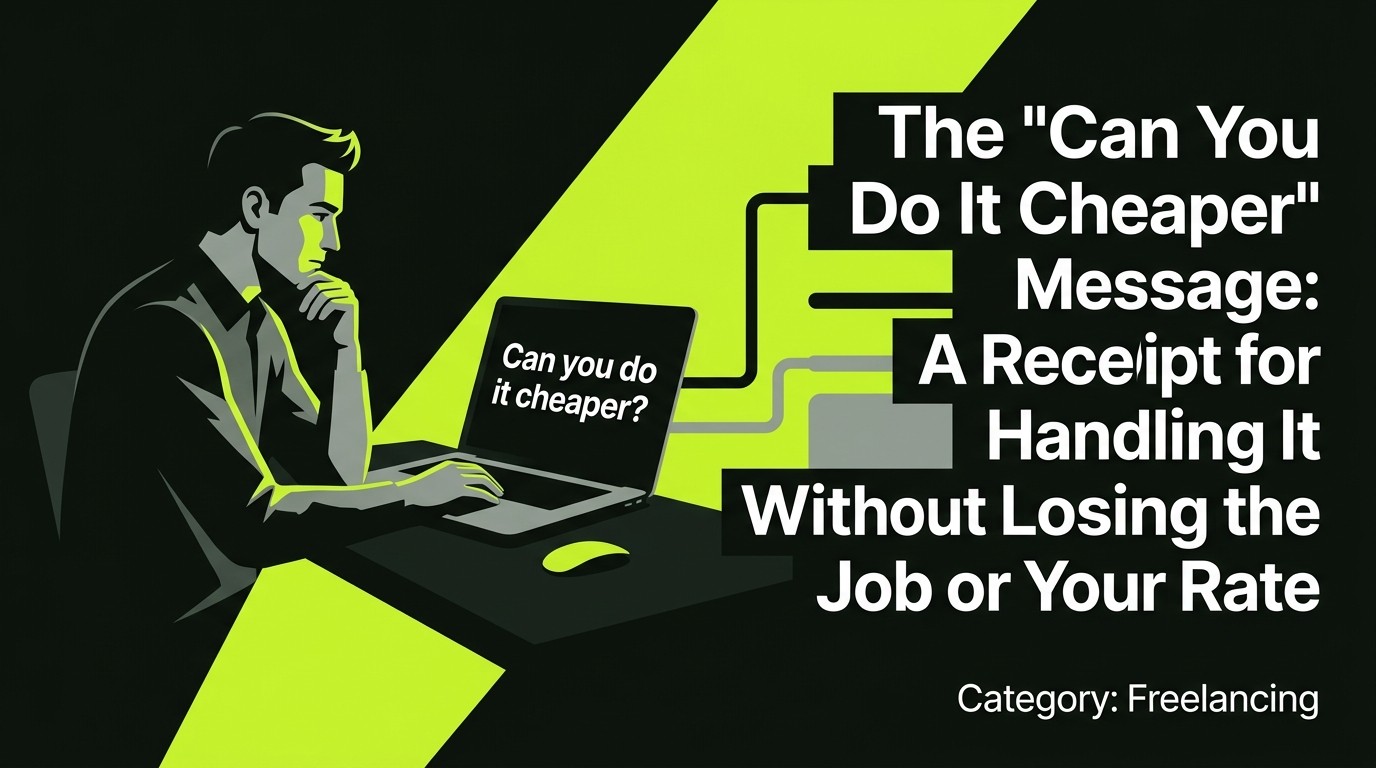
You send a proposal. The client replies in four words: "Can you do it cheaper?"
Most engineers fold immediately or ghost the thread. Both are mistakes.
This is not a rejection. It is a negotiation opening - and how you respond in the next 90 seconds determines whether you win the job at a good rate, win it at a bad rate, or lose a client who was actually ready to hire.
Here is the full receipt.
Step 1 - Read the signal before you reply
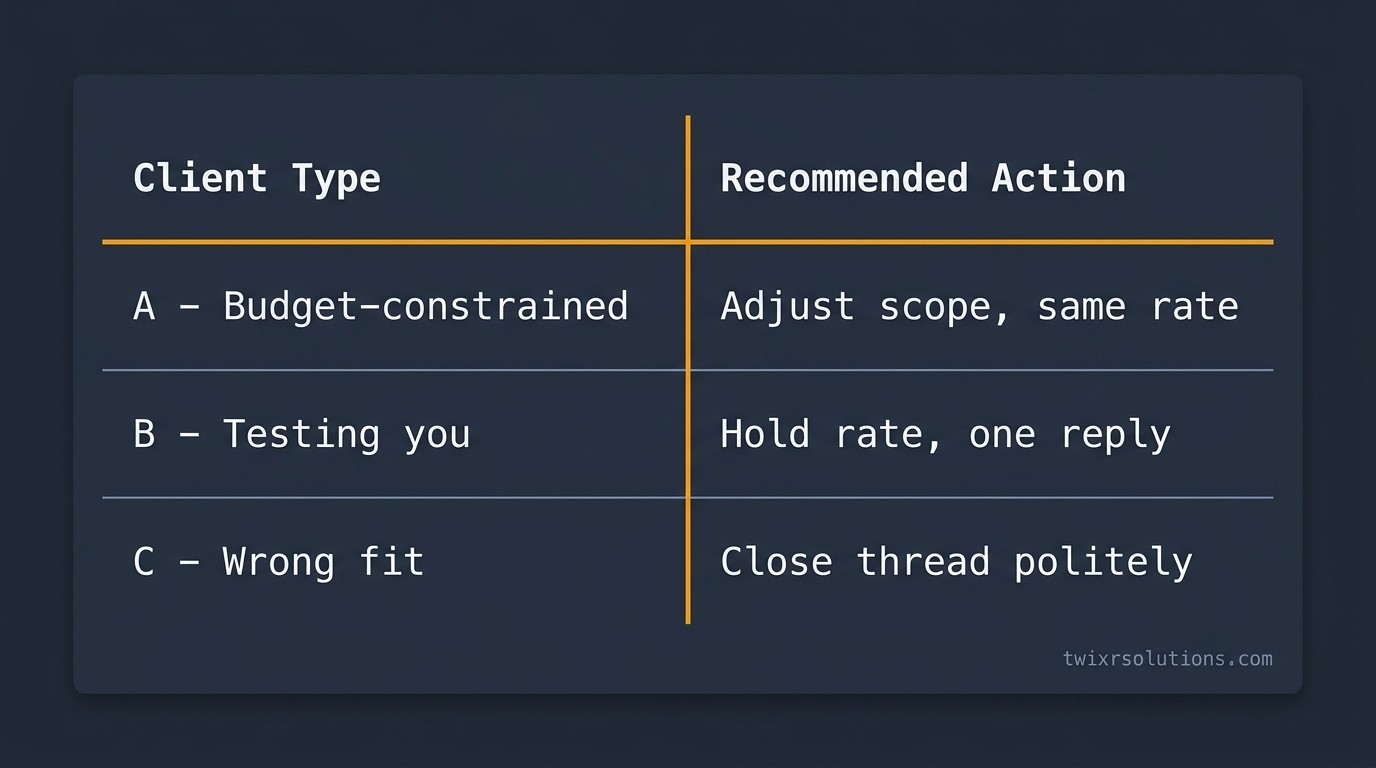
Not every "cheaper" message means the same thing. There are three types:
Type A - Budget-constrained. They have a real ceiling. They like your proposal. They want to find a way to make the numbers work.
Type B - Testing you. They want to see if you panic and discount on demand. This is common with clients who have hired before. They are checking whether you believe your own price.
Type C - Wrong fit. They want $500 of work for $50. No response saves this one.
You can usually tell which type you are dealing with from the rest of the thread. Type B clients tend to have detailed job posts and have already interviewed multiple candidates. Type C clients tend to have vague briefs and no real budget listed.
If you cannot tell, your first reply will reveal it.
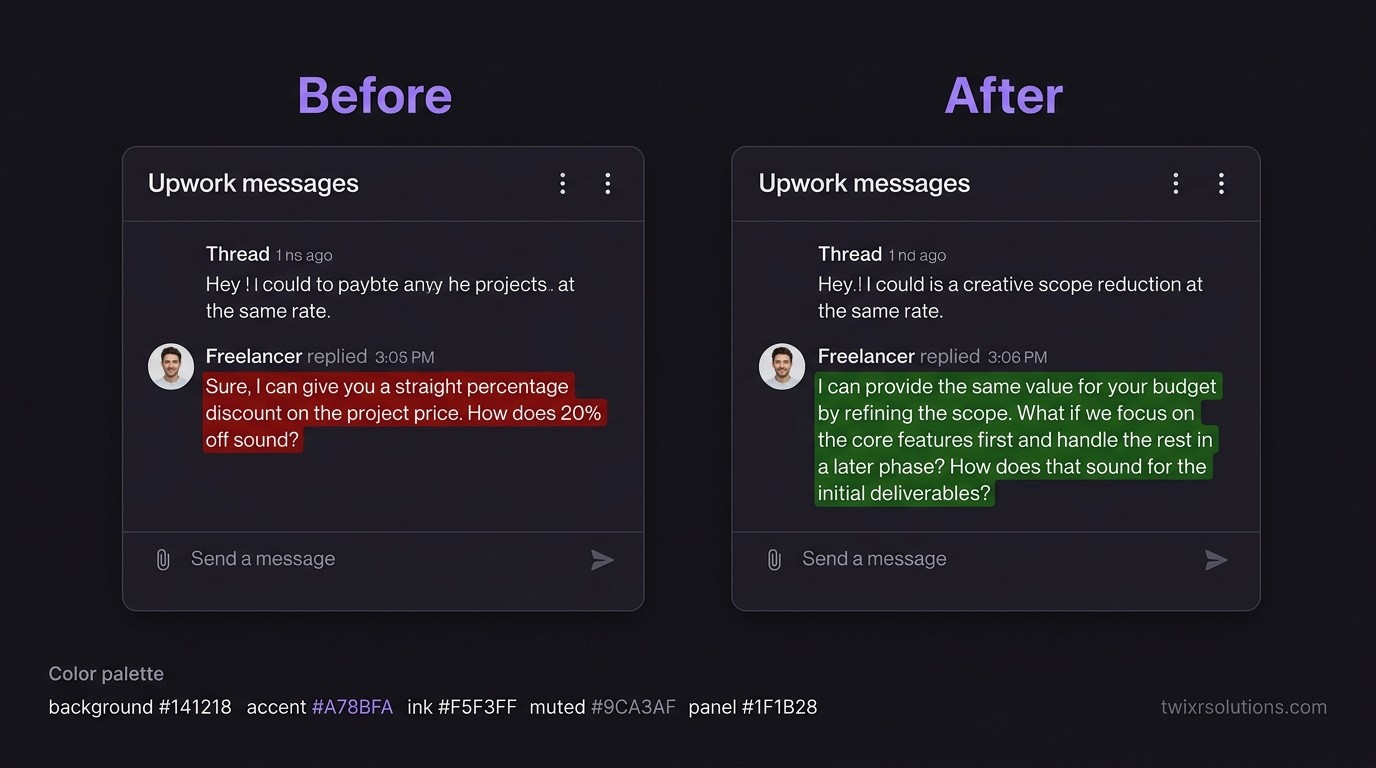
Step 2 - Do not discount. Adjust scope.
This is the single rule that separates engineers who build sustainable practices from engineers who race to the bottom.
Discounting signals: "my price was negotiable all along, and I will negotiate again next time."
Adjusting scope signals: "my rate is fixed. The deliverables are the variable."
Your reply should do three things:
- Acknowledge the constraint without apologizing for your price.
- Offer a reduced scope at the same rate (or a phased approach).
- Ask one clarifying question to confirm what they actually need.
Example structure (adapt the words to your voice):
"Happy to work within a tighter budget. To do that, I would need to trim scope rather than the rate. The current proposal covers X, Y, and Z. If we drop Z and phase Y into a second milestone, I can bring the first milestone to [lower number] while keeping the same quality bar. Does that direction work, or is there a specific part of the scope you see as optional?"
That response does four things: it holds the rate, it gives them a real option, it shows you thought about their problem, and it puts the decision back in their hands.
Step 3 - Give them one option, not three
Engineers love exhaustive options. Clients find them overwhelming.
Offer one trimmed scope. If they want further changes, they will ask. If you front-load three tiers plus a "custom" option, you have turned a simple message thread into a pricing negotiation that benefits no one.
One option. One question. Wait.
Step 4 - Know your walk-away number before any proposal goes out
If you do not have a walk-away number before the client replies, you will invent one under pressure and it will be too low.
Before you submit any proposal, decide: what is the minimum engagement I will accept for this job? If the client's counter falls below that number, the right answer is a polite close.
"I understand - at that budget, I would not be able to deliver the quality this project needs. If the budget changes, feel free to reach back out."
That reply takes eight seconds to send and costs nothing. It also occasionally brings the client back at the right number.
Step 5 - Recognize the Type C client and close the thread cleanly
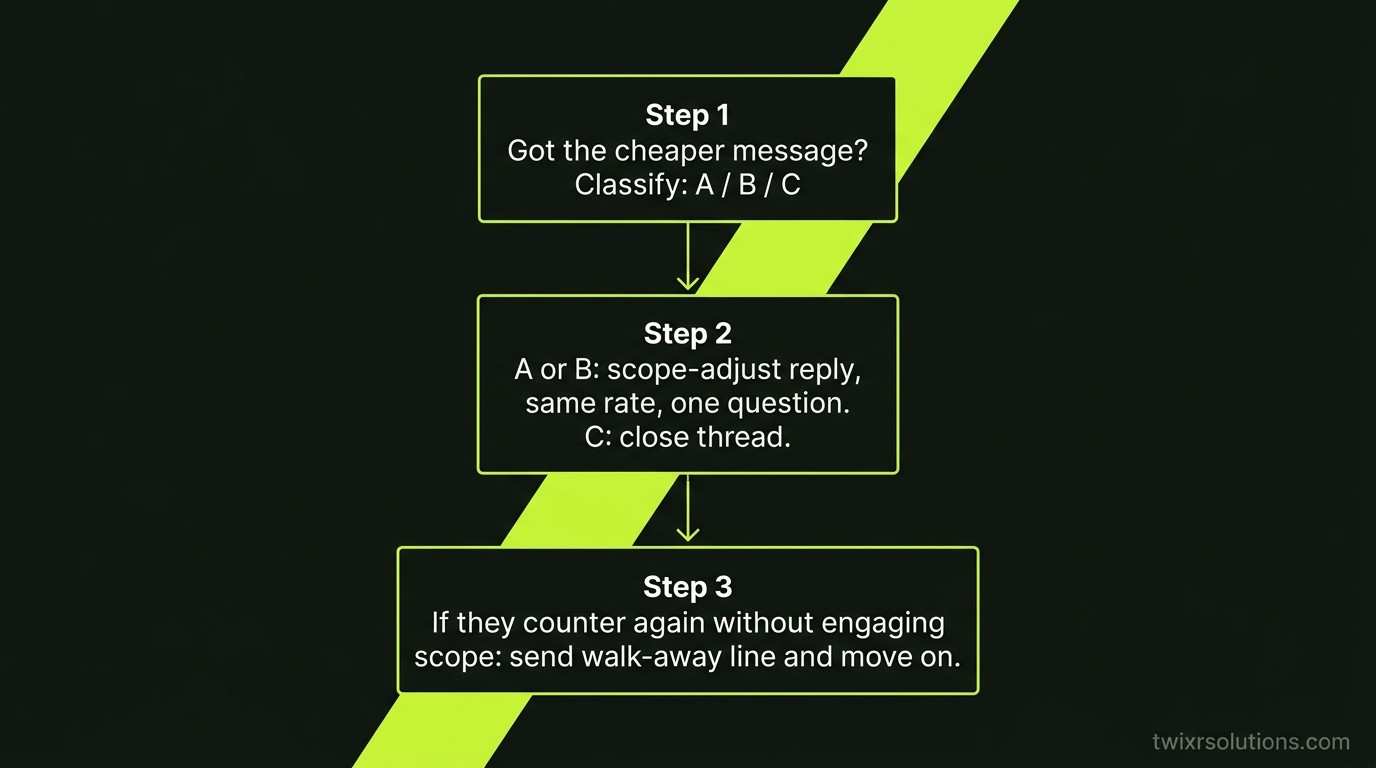
If the client's first response to your scope-adjustment offer is another round of "can you go lower?" without engaging on the scope question, you are in Type C territory.
Do not keep negotiating. Each reply you send trains them that continued pressure works.
Close it politely. Move on. The time you spend defending a $200 discount is time you are not spending on a $2,000 client.
The actual receipt (run this every time)
- Read the message. Classify it: A, B, or C.
- If A or B: reply with a scope adjustment, same rate, one clarifying question.
- If C: close the thread with one polite line.
- Never discount without a scope change attached.
- Never offer more than one alternative in the first reply.
- If they counter again without engaging on scope: close it.
That is the whole playbook. It fits on an index card.
Before you get to this message
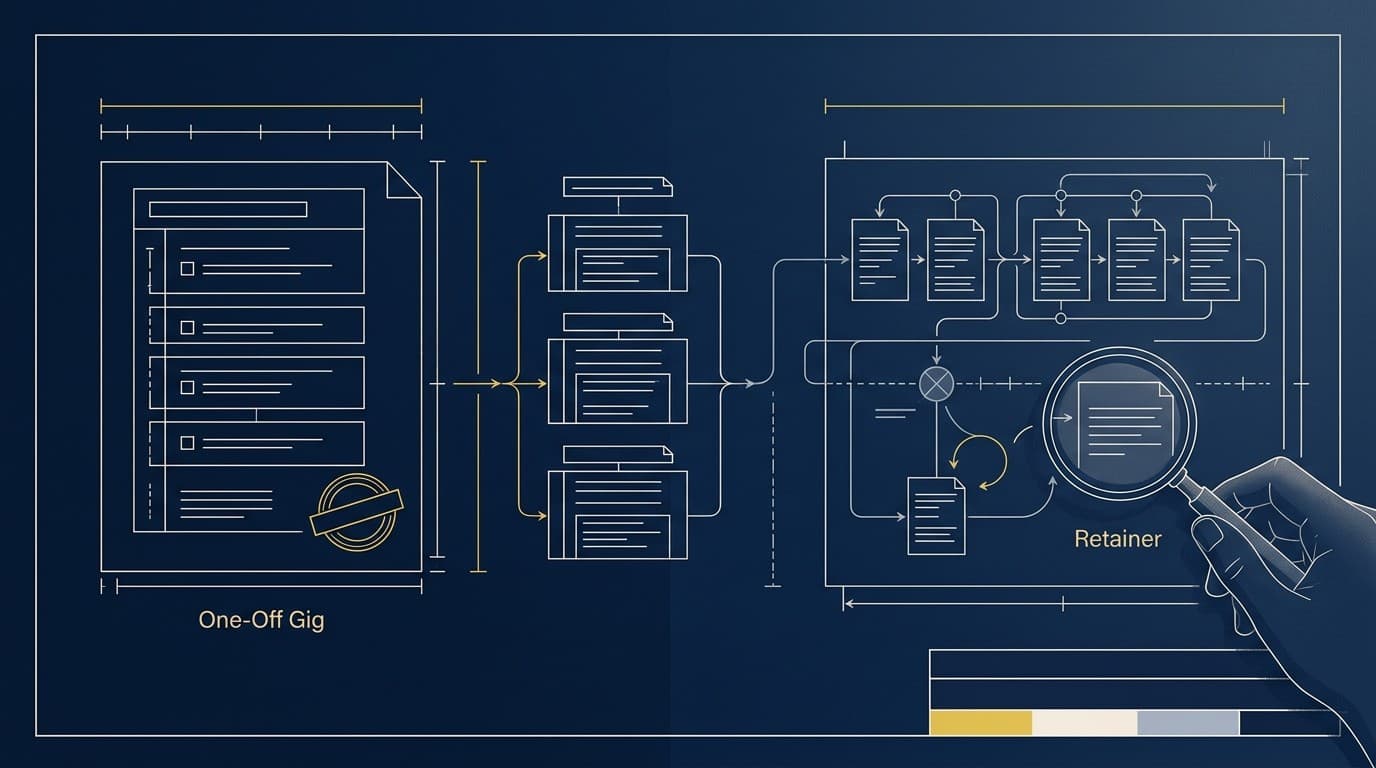
The best defense against "can you do it cheaper" is a proposal that pre-empts the question. If your opening line anchors on the outcome you deliver rather than the hours you charge, price resistance tends to arrive later and softer.
For more on how to open a proposal in a way that sets the right frame, see The Proposal Opening Line That Wins (And Why Yours Probably Isn't It).
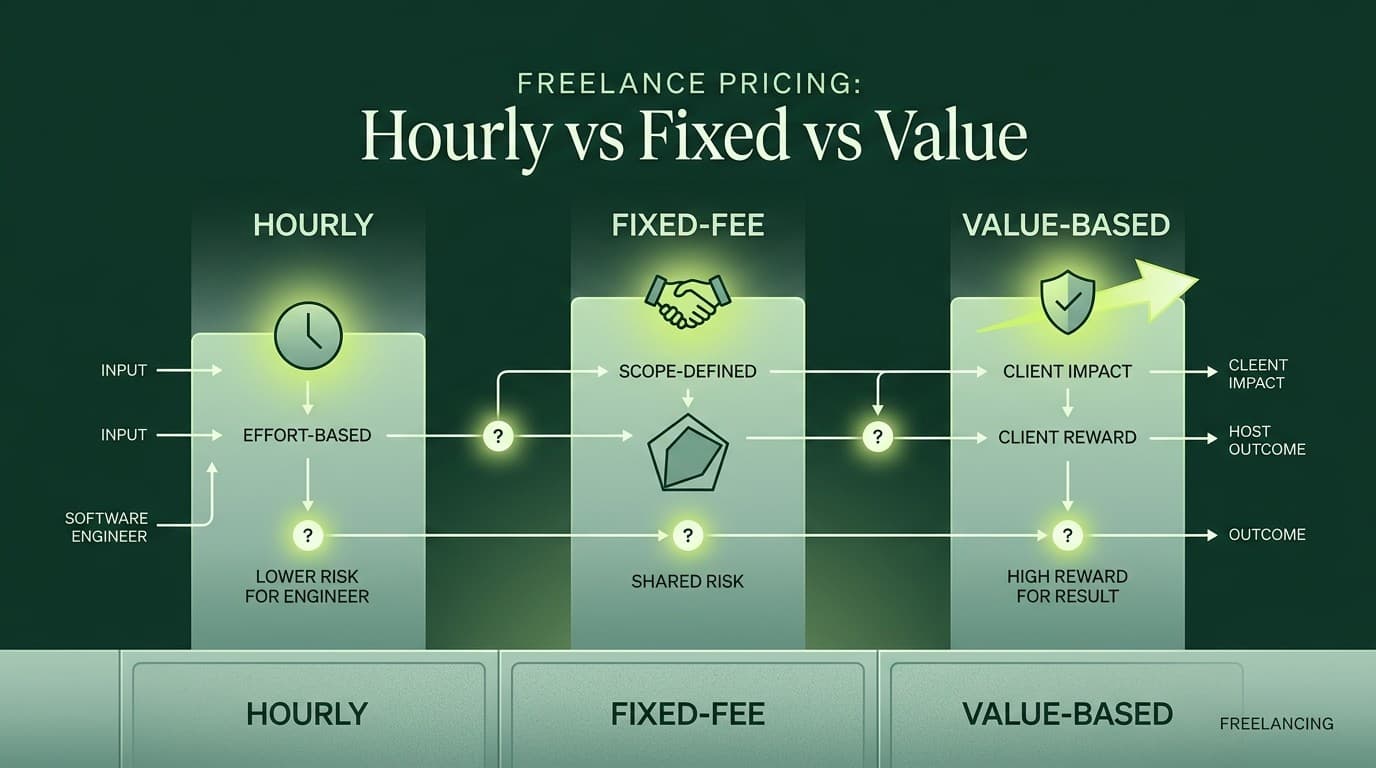
If the price negotiation keeps happening and you are not sure whether your pricing model is part of the problem, Freelance Pricing: Hourly vs Fixed vs Value - A Decision Table for Engineers walks through when each model works and when it backfires.
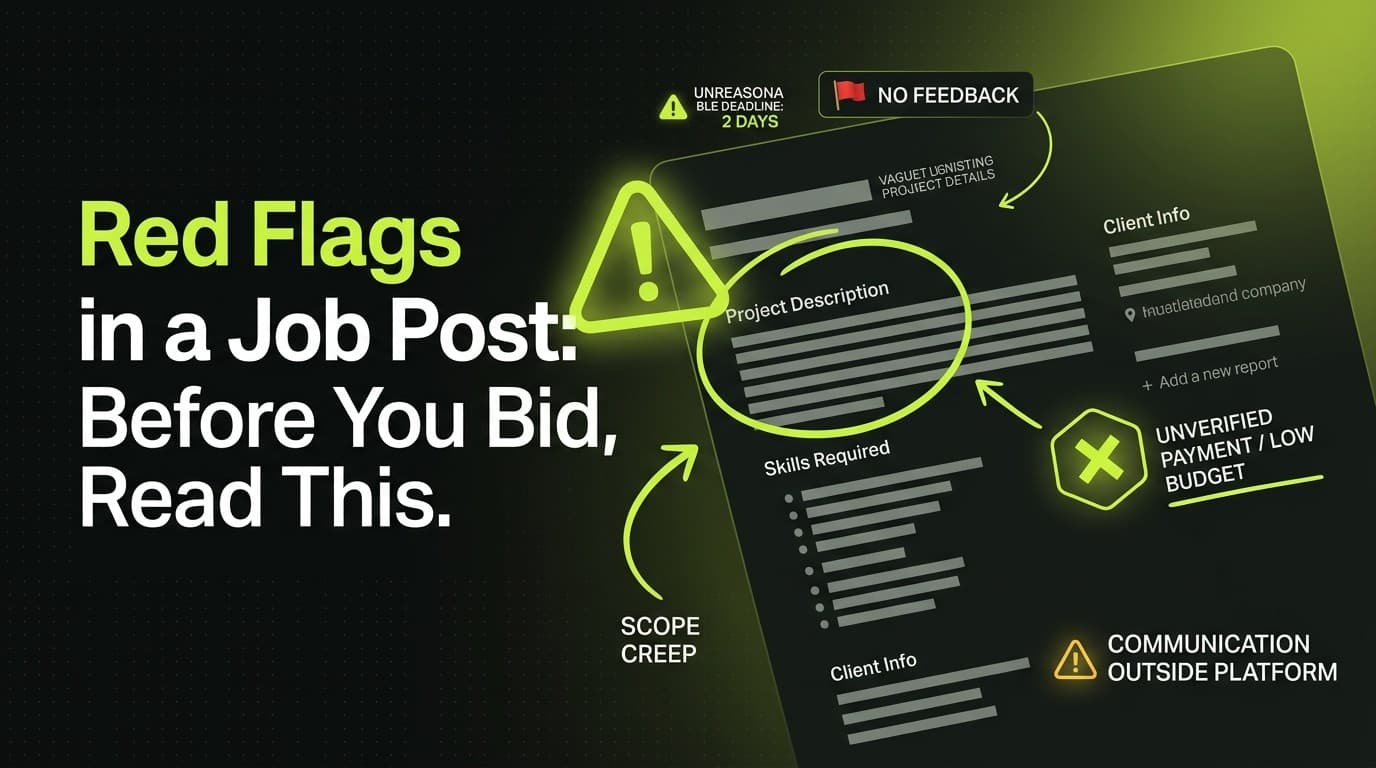
And if you are still in the proposal-reading phase, Red Flags in a Job Post: Before You Bid, Read This will help you filter out the Type C clients before they cost you an hour of back-and-forth.
The "can you do it cheaper" message is not a problem. It is a filter. Run the receipt, and it filters for you.
Frequently asked questions
Rarely, and almost never in response to a first 'cheaper' message. Direct discounting signals that your original price was inflated and that pressure works. The better move is to adjust scope at the same rate - you protect your hourly or project floor, and the client still gets a path forward within their budget.
Acknowledge it without competing on price. A reply like 'I understand there are cheaper options - if the priority is the lowest number, those may be the right fit. If the priority is [specific outcome you deliver], here is what my rate covers' puts the decision on value, not cost. Some clients pivot. The ones who do not were not your clients anyway.
Frame the removed items as a logical second phase, not as cuts. 'We can ship the core feature set in milestone one and revisit the reporting dashboard and admin panel once you have validated the initial build' sounds like a plan, not a downgrade. It also opens the door to a second contract.
Yes - when you genuinely need the work, when the project gives you a portfolio piece you want, or when a long-term client relationship justifies a one-time flexibility. But that should be a deliberate business decision you make before replying, not a panic response to a four-word message. Know your walk-away number first.
Enjoyed this article?
Get notified when I publish new posts on SaaS, Laravel, and remote engineering.