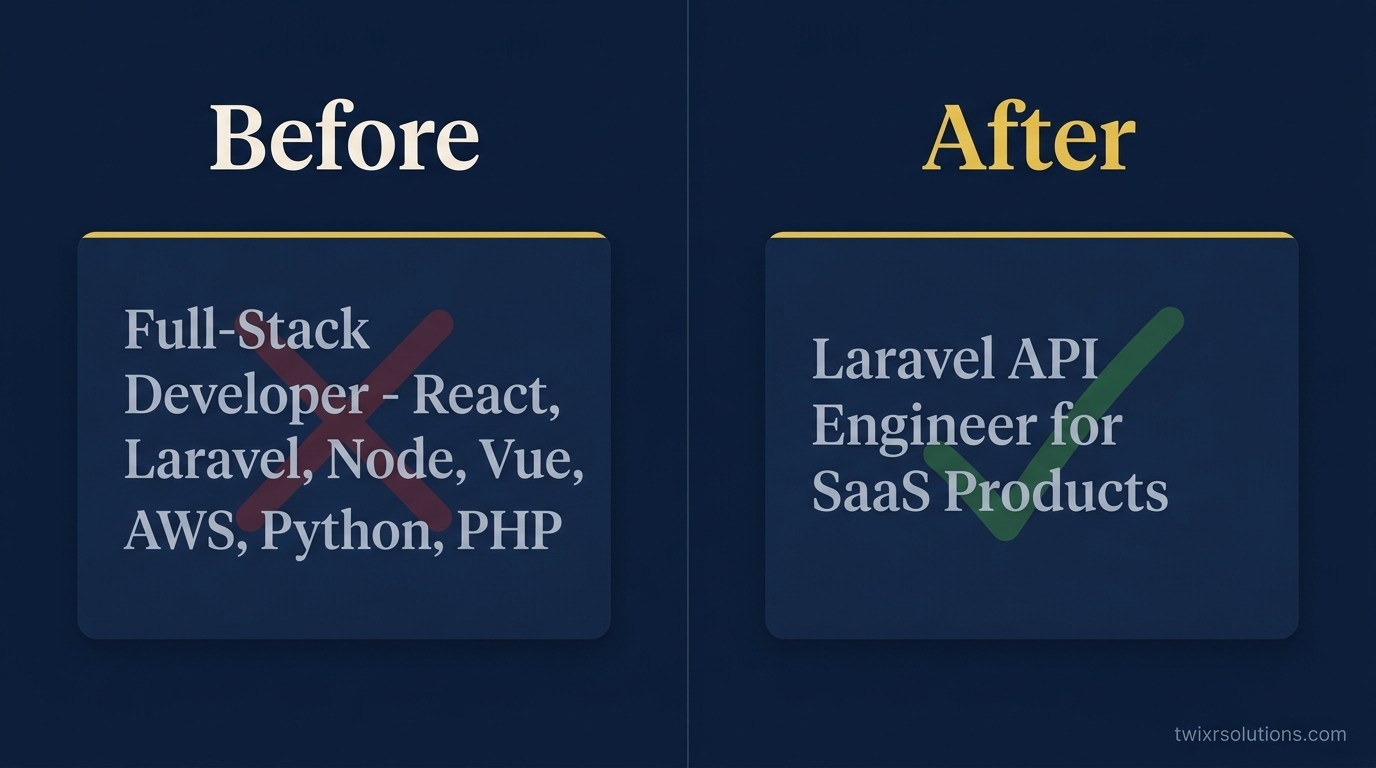
Your Upwork profile says "Full-Stack Developer - React, Laravel, Node, Vue, AWS, Python, PHP." So does every other profile on page one.
That is not positioning. That is a skills dump. And clients skip it.
The engineers landing $60-100/hr contracts are not more skilled than you. They are more specific. A client with a SaaS billing problem does not want a generalist. They want someone who has fixed that exact problem before.
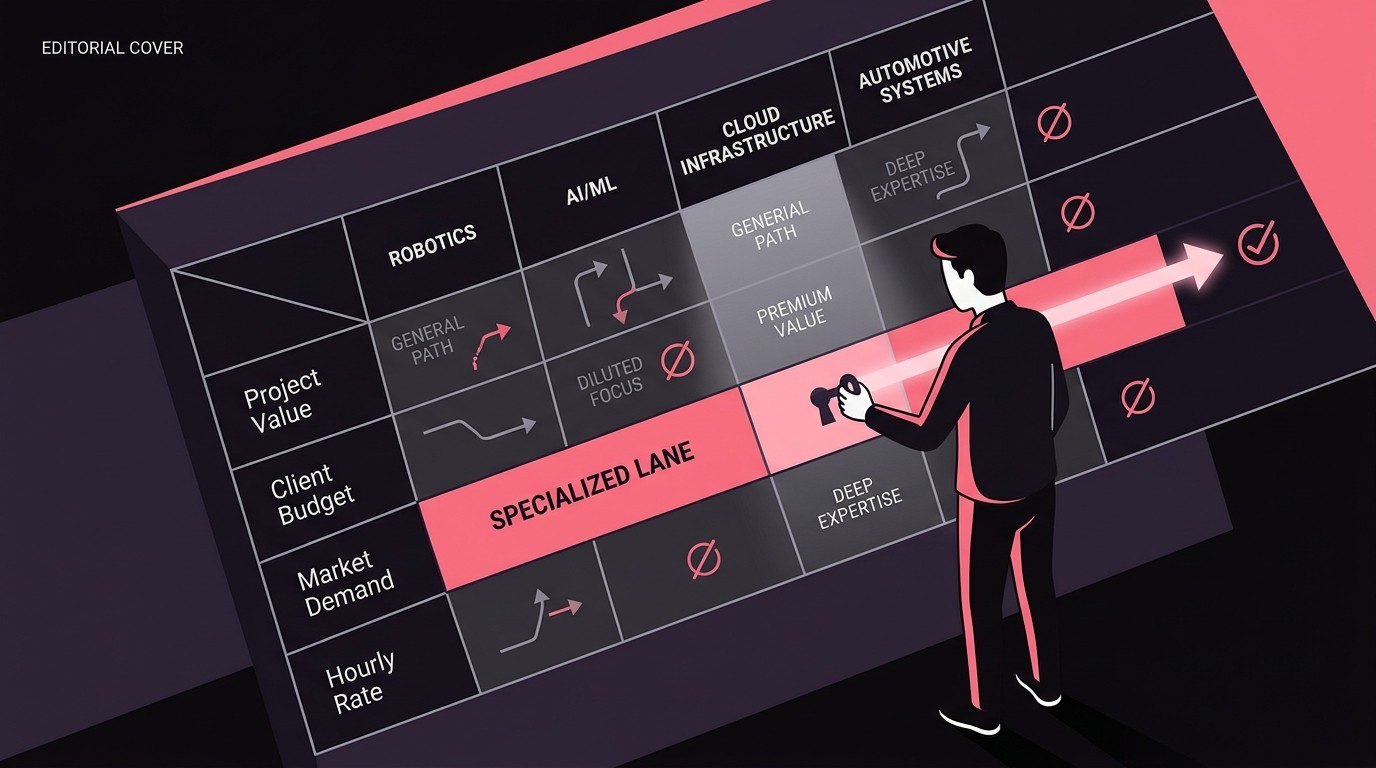
This post gives you a concrete decision table to figure out where to specialize - and what to do once you pick a lane.
Why Generalist Profiles Lose
Clients hire for outcomes, not capabilities. When a founder posts a job, they have a specific pain: "our Laravel API is too slow," "our Stripe webhooks keep failing," "we need a multi-tenant data layer." They read proposals and look for signal that you have handled this before.
A profile that covers everything signals nothing.
Specialization does three things for you:
- Raises your perceived expertise on the exact problem the client has
- Reduces proposal competition (fewer specialists compete with you than generalists)
- Lets you charge for outcomes, not hours - because you can estimate and deliver with confidence
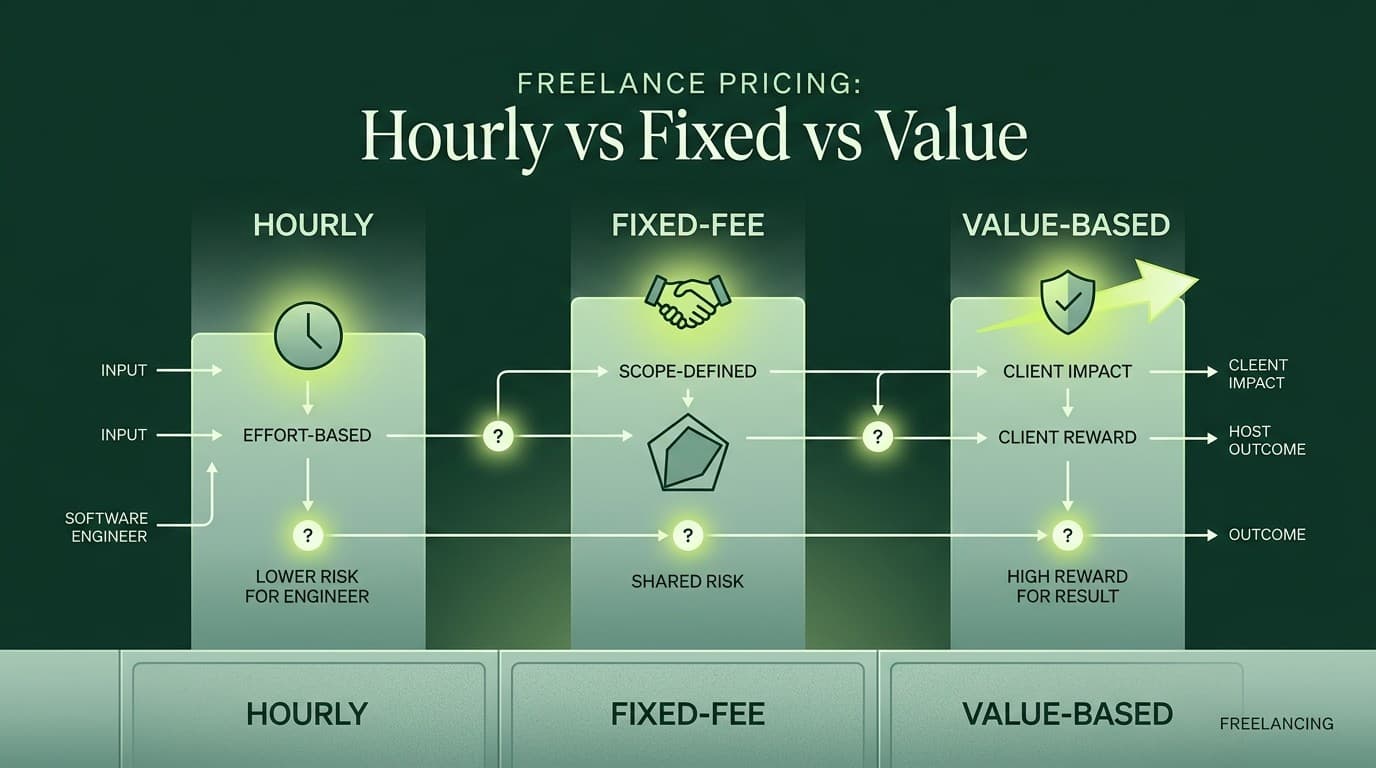
Check Freelance Pricing: Hourly vs Fixed vs Value - A Decision Table for Engineers once you pick a lane. Specialists are far more likely to make fixed and value pricing work.
The Decision Table: Which Lane Should You Pick?
Use your honest answers to these four signals. No lane is permanent - you can move after 6-12 months once you have built a track record in one.
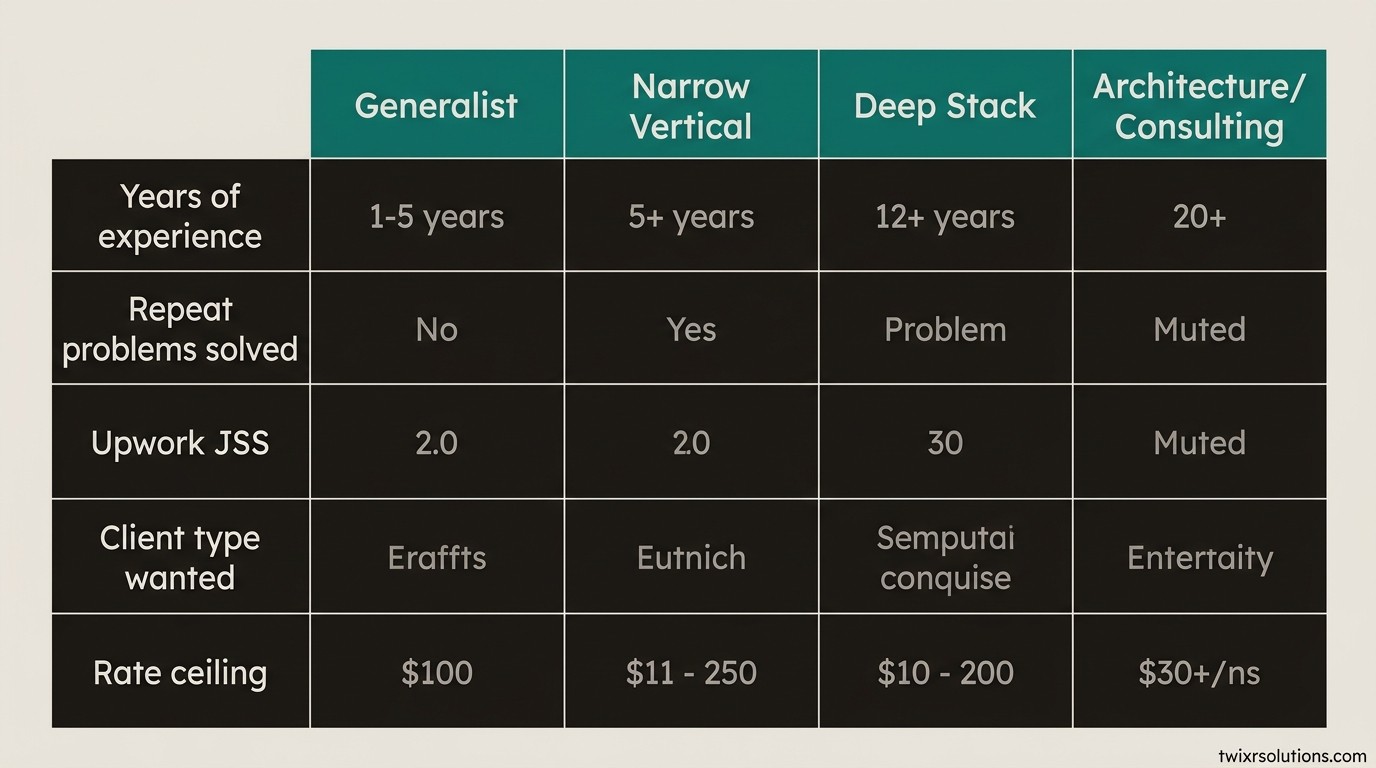
| Signal | Generalist (keep broad for now) | Narrow Vertical (e.g. SaaS billing, fintech APIs) | Deep Stack (e.g. Laravel + AWS + Stripe) | Architecture / Consulting |
|---|---|---|---|---|
| Years of experience | 0-2 yrs | 3+ yrs | 4+ yrs | 6+ yrs |
| Repeat problems you've solved | Varied, no pattern | Same domain (e.g. multi-tenancy, payments) | Same stack combinations | System design, team review |
| Current Upwork JSS | Building it up | 90%+ with some reviews | 90%+ with stack-specific reviews | Top Rated or Top Rated Plus |
| Client type you want | Any (volume) | SaaS founders, product companies | CTOs, technical leads | Series A+ or agencies |
| Proposal win rate | Low - high volume needed | Moderate with right job targeting | High when stack matches exactly | Low volume, high value |
| Rate ceiling on current path | $25-40/hr | $50-80/hr | $60-100/hr | $100+/hr or fixed project |
Read each row across. Where do you land most often? That column is your next move.
How to Actually Make the Shift
Picking a lane is cheap. Executing it takes 4-6 weeks of deliberate repositioning.
Step 1 - Rewrite your profile title. One sentence, one outcome, one stack. "Laravel API Engineer for SaaS Products" beats "Full-Stack Developer." That is it. No list of technologies in the title.
Step 2 - Audit your portfolio. Pull the 3 projects most relevant to your chosen lane. Write each as a problem/solution story. "Client had X problem. I built Y using Z. Result was [measurable change]." If you have no portfolio pieces in your lane yet, do a small personal or open-source project that demonstrates the core skill.
Step 3 - Retarget your proposals. Stop bidding on everything. Bid only on jobs that match your lane. Your win rate will drop short-term on volume, then rise sharply on fit. Read The Proposal Opening Line That Wins (And Why Yours Probably Isn't It) - a specialist proposal is worthless if the opening line is generic.
Step 4 - Say no to off-lane work. This is the hard one. A $500 WordPress job when you are positioning as a NestJS microservices engineer drags your review profile sideways. Off-lane work = off-lane reviews = weaker signals for the clients you actually want.
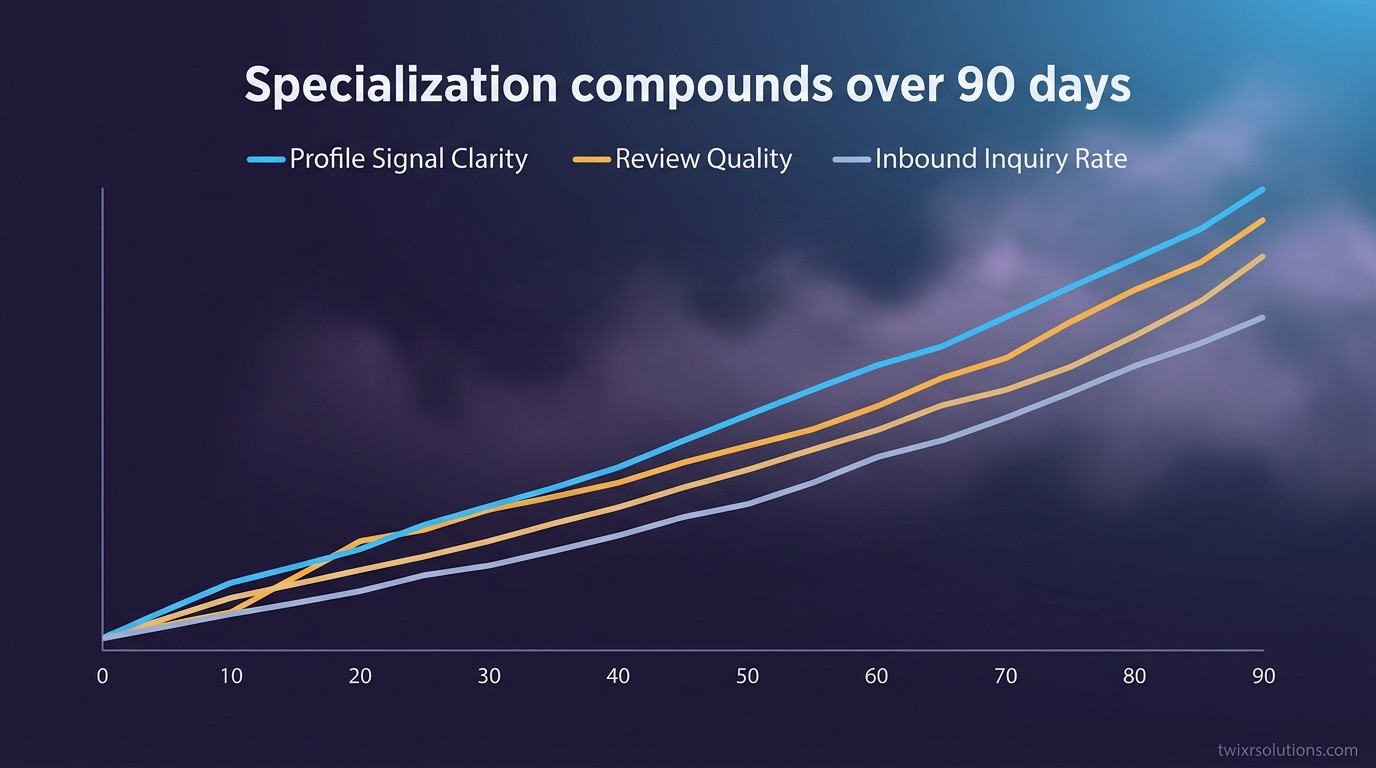
Step 5 - Repeat for 90 days. Profile, proposals, and job targeting all pointing at one lane for 90 days. Then measure: are better clients finding you? Is your close rate improving? Adjust or double down.
Common Objections, Addressed Directly
"I will miss out on work if I narrow down." You will miss out on low-rate, high-competition work. That is not a loss. Specialists get fewer irrelevant inquiries and more qualified ones.
"My stack is too niche, there are not enough jobs." If your lane has fewer than 20-30 relevant jobs posted per week on Upwork, it is probably too narrow. Zoom out one level. "Laravel + Stripe integrations" might be too narrow; "Laravel API engineer for SaaS products" is specific but still has volume.
"I need to earn now, I can't afford to specialize." Fair. Keep the generalist work short-term to pay bills. But use 20% of your proposal time to test specialist targeting. Run both tracks for 60 days. Compare close rates and rates offered. The data will convince you faster than any argument.
One More Thing on Job Targeting
Specializing also changes which jobs you should even bother opening. A specialist learns to read job posts differently - the budget, the description quality, and the client history all send strong signals before you spend a single connect.
Red Flags in a Job Post: Before You Bid, Read This is worth reading before you start applying with your new positioning. Being specific about your lane makes red flags easier to spot - you know exactly what a well-scoped job in your domain looks like, so a vague or unrealistic one sticks out immediately.
The Short Version
Generalist = competing with everyone, on price.
Specialist = competing with fewer people, on fit and expertise.
Pick one lane. Rewrite your profile for it. Bid on relevant jobs only. Give it 90 days. The compounding effect of a coherent signal - same stack, same outcome, same client type - builds a review profile that attracts inbound instead of chasing volume.
The engineers doing well on Upwork are not lucky. They are legible.
Frequently asked questions
Narrow enough to stand out, broad enough to have volume. A good rule of thumb: if you can find 20-30 relevant job posts per week on Upwork matching your lane, the scope is workable. If you struggle to find 10, zoom out one level. 'NestJS microservices engineer for SaaS products' is more useful than 'NestJS engineer for healthcare SaaS on AWS in the US market.'
Short-term, your proposal volume will drop if you stop bidding on off-lane jobs. That is expected. Your close rate on relevant jobs should improve within 4-8 weeks. The metric to watch is not proposals sent but qualified conversations started. If that number is rising, the transition is working.
Pick one for your main Upwork profile and positioning. You can have a secondary profile or mention complementary skills lower in your overview. But the title, the first three lines of your overview, and your portfolio highlights should all point at one lane. Clients read fast. Confusion is a skip.
Most engineers see a shift in inquiry quality within 60-90 days of consistent repositioning - profile rewrite, targeted proposals, and on-lane job selection all active at the same time. The review profile takes longer to shift because existing reviews reflect past work. That is normal. New reviews in your lane gradually reweight your signal for the algorithm and for clients scanning your history.
Enjoyed this article?
Get notified when I publish new posts on SaaS, Laravel, and remote engineering.